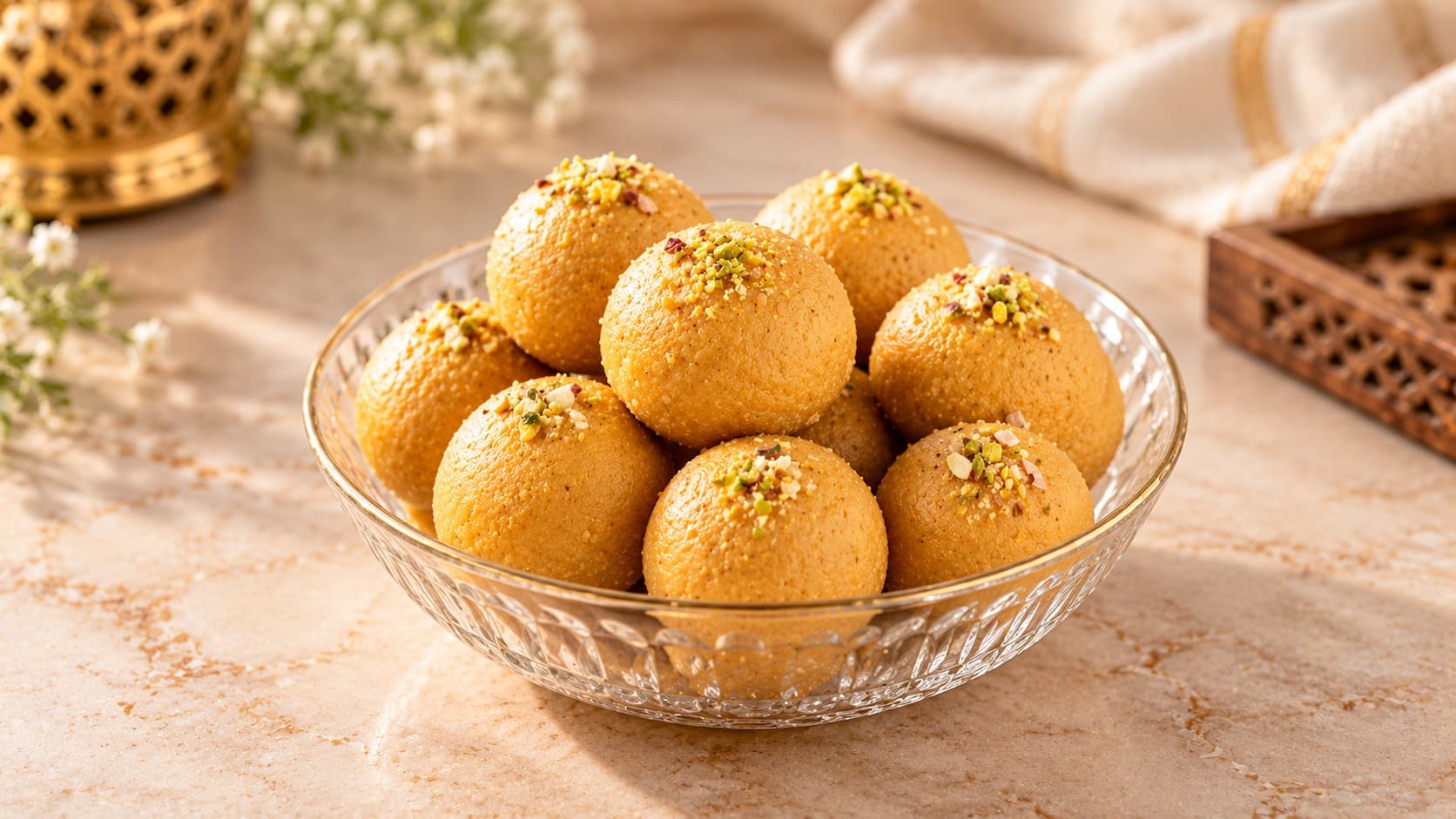
Besan Ladoo is a classic Indian sweet made by slowly roasting gram flour in pure ghee until deeply aromatic, then blending it with powdered sugar and fragrant cardamom. These beautiful golden-yellow, round sweets have a rich, toasted, nutty flavor and a delicate, melt-in-the-mouth texture with a subtle traditional graininess. This homemade version uses carefully balanced ingredients and gentle roasting to create soft, flavorful, sweet-shop-style ladoos that hold their shape beautifully, making them perfect for Diwali, Ganesh Chaturthi, festive celebrations, and gifting.

Md Afroz Alam
0 followers
30
Cook Time
16
Servings
0
0 reviews
Medium
Difficulty
Measure 220 grams of fresh besan, 160 grams of boora sugar or finely powdered sugar, and 110 grams of pure desi ghee. If using regular granulated sugar, grind it in a completely dry mixer-grinder until it becomes a fine powder, then set it aside. Check the besan for freshness and a clean, neutral aroma, without any bitter or rancid smell. If the flour contains large lumps, sift it through a medium sieve. Slightly coarse ladoo besan is ideal for achieving the characteristic delicate, grainy texture found in traditional Indian sweet shops. Measure the ground cardamom and prepare the optional pistachio garnish before beginning.
Traditional boora sugar gives besan ladoo a particularly pleasant texture because its fine crystals blend easily with the roasted flour without turning the mixture into a syrup. Avoid coarse granulated sugar, which can produce unpleasant hard crystals in the finished sweets.
Place a heavy-bottomed kadai, thick cast-iron skillet, or sturdy nonstick saucepan over low heat. Add 110 grams of pure desi ghee and warm it gently for approximately 1–2 minutes until completely melted. The ghee should become clear and fluid without smoking, browning, or producing a strong frying sound. Keep the burner at its lowest practical setting before adding the besan. A broad pan with a thick base helps distribute heat evenly and prevents scorching during the extended roasting process.
Use fresh, high-quality ghee because its flavor is central to authentic besan ladoo. Avoid excessively high heat; besan can brown on the outside before losing its raw flavor internally.
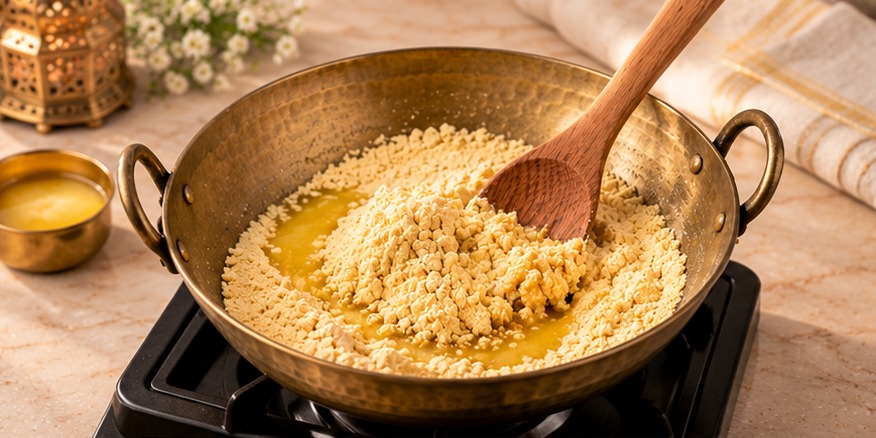
Add the measured besan to the melted ghee in two or three additions, stirring continuously with a sturdy wooden spoon or heat-resistant silicone spatula. Mix thoroughly after each addition until the ghee is evenly distributed throughout the flour. Initially, the mixture may appear thick, crumbly, and slightly dry, resembling damp sand or a dense paste. Continue stirring over low heat for approximately 4–5 minutes, pressing any lumps against the base of the pan. The mixture should gradually become more uniform as the flour absorbs the warm ghee.
Do not add water or milk to loosen the mixture. The texture will naturally change as the besan roasts and the ghee becomes evenly incorporated.
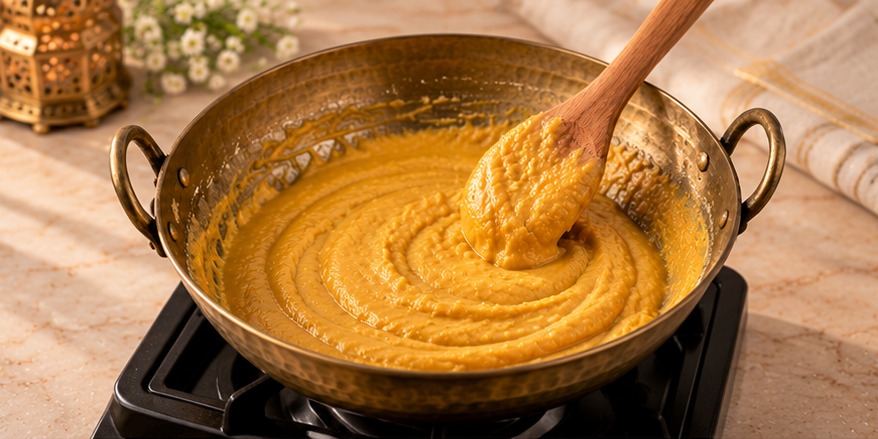
Continue roasting the besan and ghee mixture over low heat for approximately 20–25 minutes, stirring almost continuously and scraping the bottom, sides, and corners of the pan. During the first 8–10 minutes, the mixture will remain relatively thick and may look slightly lumpy. As roasting continues, it will gradually loosen, become smoother, and develop a warm golden-yellow color. After approximately 15–20 minutes, the aroma should change from raw flour to a rich, distinctly nutty, toasted fragrance. Towards the end, the mixture will appear softer and more fluid, with a delicate natural ghee sheen and possibly a small amount of ghee becoming visible on the surface. The finished besan should be uniformly golden with a lightly toasted color, without dark brown spots or a burnt smell. Roasting time varies with pan thickness and burner strength, so prioritize the aroma, texture, and color over the clock.
This is the most important stage of the entire recipe. Under-roasted besan tastes raw and can feel sticky or pasty, while over-roasted flour develops a bitter flavor. Keep the heat low, stir consistently, and remove the mixture from the stove when it smells pleasantly toasted and loses its raw aroma.
As soon as the besan is properly roasted, turn off the heat and transfer the mixture into a wide, clean, dry stainless-steel or heat-resistant mixing bowl. Spread it gently across the bottom of the bowl to release excess heat. Allow it to cool naturally for approximately 15–20 minutes, stirring occasionally to prevent heat from remaining trapped in the center. The mixture should become comfortably warm rather than hot, ideally around 95–104°F (35–40°C), before adding the sugar. It should still be pliable and slightly soft, but not hot enough to dissolve the powdered sugar rapidly.
Adding sugar when the besan is extremely hot can melt the sugar and make the mixture sticky, oily, or difficult to shape. Allowing it to cool too far may cause the ghee to solidify and make mixing more difficult. A comfortably warm mixture provides the best balance.
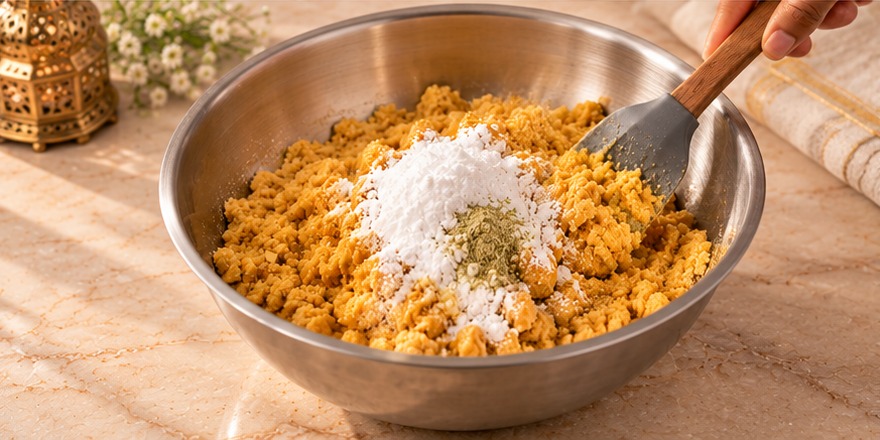
Add the 160 grams of boora or finely powdered sugar to the warm roasted besan mixture. Sprinkle in 0.5 teaspoon of ground green cardamom. Using a sturdy spatula or clean hands, fold, press, and mix thoroughly for approximately 3–4 minutes until the sugar and cardamom are evenly distributed. Break up any sugar lumps and repeatedly fold the mixture against the bottom of the bowl to achieve a uniform consistency. The mixture should become slightly thicker, soft, and cohesive, with a beautiful warm golden color and tiny natural grains from the roasted besan. Taste a small portion to confirm that the raw flour flavor has disappeared and the sweetness is evenly balanced.
Do not return the sugar mixture to direct heat. The sugar should remain finely dispersed throughout the roasted besan rather than melting into liquid syrup. This helps produce the classic tender, slightly grainy texture of traditional besan ladoo.
Take approximately 1 tablespoon of the prepared mixture in your palm and squeeze it gently but firmly. The mixture should hold together as a compact mass without immediately falling apart or releasing excessive liquid ghee. If it holds together, it is ready for shaping. If the mixture seems too soft or greasy, allow it to cool for another 10 minutes; a brief 10–15-minute rest in the refrigerator can help in a very warm kitchen. If the mixture is excessively dry and refuses to bind, gently warm an additional small amount of ghee separately and incorporate it gradually, approximately 1 teaspoon at a time, until the mixture becomes workable. Allow it to settle before shaping.
The ideal mixture should feel slightly soft and buttery, not wet or liquid. A properly roasted and balanced mixture becomes firm enough to hold a rounded shape as the ghee cools.
Divide the prepared mixture into 16 approximately equal portions, each weighing around 30 grams. Take one portion in your palm and press it firmly between your fingers to compact the mixture. Rotate it gently while applying steady pressure, then roll it between both palms to form a neat, rounded ball approximately 3.5–4 cm (1.4–1.6 inches) in diameter. Repeat with the remaining portions. The finished ladoos should have naturally rounded shapes, smooth but delicately grainy surfaces, and a rich golden-yellow appearance. Small variations in shape are normal and desirable for homemade sweets.
Pressing the mixture into a compact mass before rolling makes shaping significantly easier. Avoid aggressively rubbing or repeatedly squeezing the ladoos, as excessive handling can encourage the ghee to separate and make the surface oily.
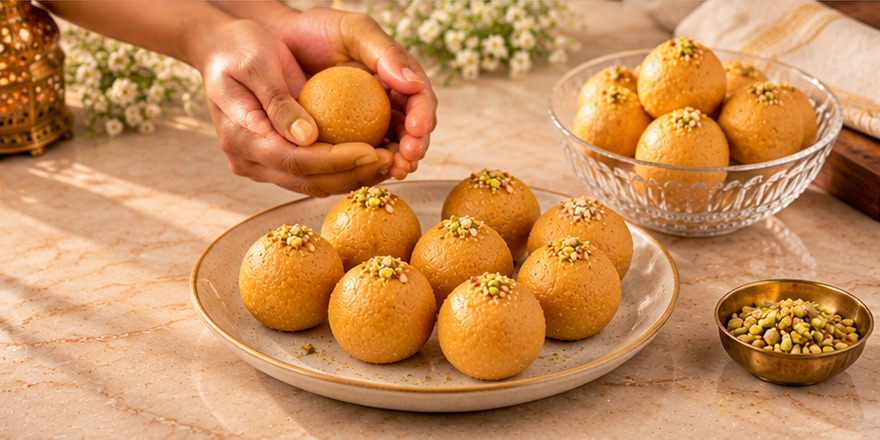
If using the optional pistachios, take a small pinch of finely chopped or slivered pistachios and gently press them onto the center of each freshly shaped ladoo. Apply only enough pressure to help the pieces adhere without flattening the sweet. Keep the garnish minimal so the warm golden surface remains the dominant visual feature. The contrast between the golden ladoos and the subtle natural green pistachio pieces creates a classic, elegant Indian mithai presentation. For a completely traditional plain version, leave the ladoos ungarnished.
Add the pistachios while the ladoos are still slightly warm and pliable so they attach naturally. Avoid excessive nuts or decorative toppings that overpower the delicate flavor of roasted besan and ghee.
Arrange the freshly shaped ladoos in a single layer on a clean, dry serving plate or parchment-lined tray, leaving a small amount of space between them. Allow them to rest undisturbed at cool room temperature for approximately 20–30 minutes so the ghee can firm up naturally and stabilize the round shapes. Once set, each ladoo should feel firm enough to lift without deforming while remaining pleasantly tender when bitten. The interior should be soft, rich, and slightly crumbly, dissolving gradually in the mouth without a raw flour sensation.
Avoid stacking ladoos immediately after shaping because their surfaces may still be soft. Allow them to set completely before transferring them into storage containers or gift boxes.
Arrange the finished besan ladoos on an elegant ceramic platter or traditional Indian mithai serving plate. Serve at room temperature to enjoy their full roasted aroma and rich, melt-in-the-mouth texture. For storage, place the completely cooled ladoos in a clean, dry, airtight container with parchment paper between layers if stacking is necessary. Keep them in a cool, dry location away from direct sunlight and consume within approximately 10–14 days for the best freshness. In hot or humid conditions, refrigerate in an airtight container and bring the ladoos back to room temperature before serving. If refrigerated, they are best consumed within approximately 2–3 weeks.
Besan ladoos are especially delicious with a cup of masala chai and make excellent homemade festive gifts. Store away from moisture and strong-smelling foods because ghee-based sweets can absorb surrounding odors.
Join the conversation
Log in to commentNo comments yet
Be the first to share your thoughts on this recipe!